
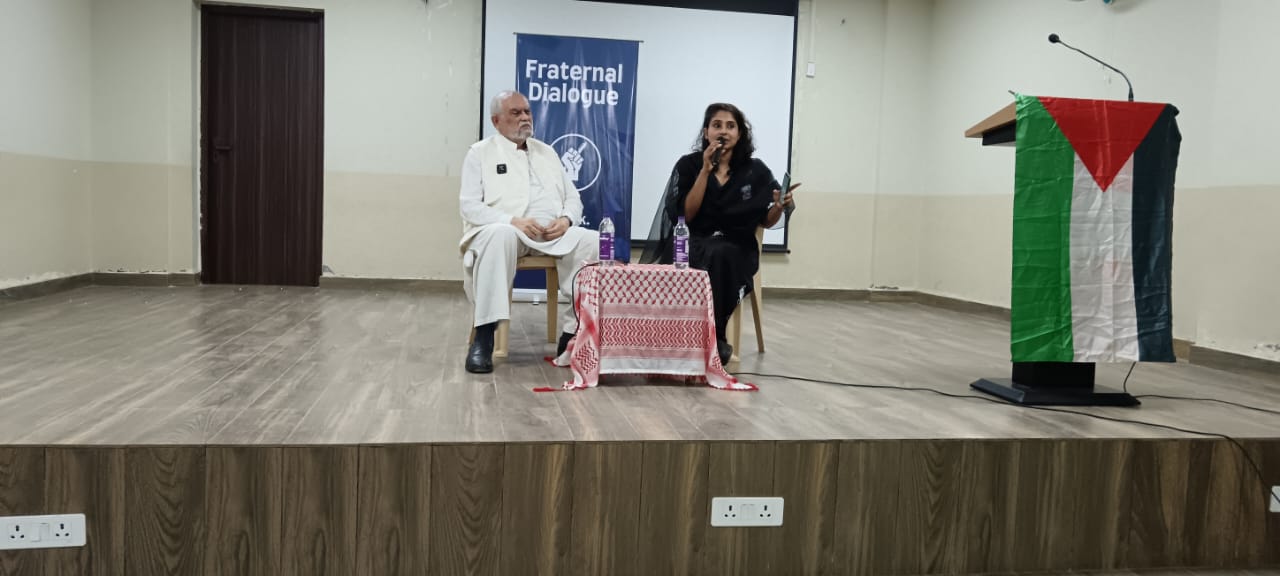
A significant fraternal dialogue organized by the Fraternity Movement, a Muslim students’ forum committed to advocating for Muslim identity in India, brought together scholars and students at the Scholar School in the Abul Fazal area of Delhi on Saturday. The event focused on India’s reaction to the ongoing Palestine crisis and the genocidal war that erupted since October 7, 2023, as well as exploring the historical relations between India and Palestine.
Misria Shaikh Ali, a postdoctoral research scholar, began her address with heartfelt gratitude toward the students present, extending appreciation to Dr. Zafarul Islam Khan for attending and to the school administration for facilitating the discussion.
Turning to the heart of the issue, Misria critically examined the dominant narratives surrounding the Palestine conflict. She challenged the tendency to depoliticize or de-Islamize the crisis by framing it solely as a humanitarian tragedy, noting that the word “Muslim” has become almost taboo in India’s political discourse. She argued that many avoid recognizing Gaza’s suffering as a Muslim issue in an attempt to garner broader support, thereby concealing its political and religious dimensions.
Misria emphasized that Palestinian suffering did not begin on October 7, 2023, as often portrayed, but traces back to Nakba Day (May 15, 1948), when nearly 700,000 Palestinians were expelled from their homeland. This displacement, she asserted, continues through relentless occupation, blockade, and bombardment.
Recalling that Hamas claimed responsibility for killing around 1,200 Israelis on October 7, Misria pointed out that between January 1 and October 6 of that same year, Israeli forces had already killed nearly 800 Palestinians. She urged the audience to remember the destruction of Gaza’s once-thriving urban landscape—now turned into rubble—and questioned why Palestinians continue to live under constant surveillance and military testing.
Addressing another popular argument, Misria countered the claim that India’s support for Israel stems from old alliances, such as Israel’s assistance during the Kargil War. She questioned the morality of maintaining such ties amid mass killings, with nearly 100,000 lives lost and over 200,000 injured, and most of Gaza’s homes destroyed. India’s historic support for Palestine, she reminded, was rooted in anti-colonial solidarity and non-alignment, shaped by the policies of Jawaharlal Nehru and other leaders who feared alienating Indian Muslims sympathetic to the Palestinian cause.
Misria also criticized the attempt by various progressive and liberal groups in India to universalize the Palestinian issue while stripping it of its Muslim identity. She highlighted the dire humanitarian situation in Gaza—widespread hunger, lack of water, medicine, and safe spaces—arguing that these conditions cannot be separated from the identity of the victims.
She asserted that Islamophobia has systematically erased Muslim voices from humanitarian narratives. India, she lamented, has lost touch with its historical consciousness and moral responsibility, betraying its once-strong sense of solidarity with oppressed peoples.
Framing Palestine as both a Muslim and humanitarian issue, Misria drew attention to women’s suffering—especially pregnant women giving birth in unsafe conditions—and warned that the normalization of genocide reflects a collective moral collapse. She concluded with a stirring message: “Our resistance is only partial. If Gaza achieves freedom, we will say enough has been done. If not, we will know we did not do enough.”
Following her speech, Dr. Zafarul Islam Khan, distinguished scholar and former chairman of the Delhi Minority Commission, expanded the discussion by exploring India’s evolving internal and external relations with Palestine.
Dr. Khan began by noting that India’s relationship with Palestine predates its independence. He cited leaders like Muhammad Ali Jauhar, Allama Iqbal, and Dr. Ansari, who championed the Palestinian cause in the early 20th century. Their advocacy resonated deeply with Palestinians, and Jauhar’s burial within the Aqsa Mosque compound in Jerusalem remains a symbolic testament to the profound India–Palestine bond.
He recalled Mahatma Gandhi’s declaration that “Palestine belongs to the Arabs as England belongs to the English,” affirming India’s historical commitment to justice and self-determination. India refused to recognize Israel in 1948, granting only limited recognition in 1952 and full diplomatic ties only after the Oslo Accords (1993), when Palestinians themselves accepted Israel’s existence.
Khan contrasted this earlier solidarity with the post-2014 shift under the Hindutva-driven political order, where open support for Israel has become part of nationalist rhetoric. He noted that past Indian governments—especially under Indira Gandhi—enjoyed close ties with Yasser Arafat, with India even donating land for the Palestinian embassy in Delhi.
According to Khan, the rise of Hindutva nationalism has diluted India’s principled stance, replacing it with transactional geopolitics. Earlier, the Palestinian cause enjoyed widespread public support across communities; now, such solidarity is largely confined to Muslim circles.
He reminded the audience that the Palestinian issue is not merely religious but a universal struggle against colonialism and injustice, drawing global empathy from people of all faiths. He traced its roots back to the 1917 Balfour Declaration, which laid the foundation for settler colonialism. The 1948 war, the 1967 Six-Day War, and subsequent occupations cemented Israel’s control over Palestinian territories.
Khan explained that despite global recognition, Palestinians remain stateless, their authority confined to limited self-rule under the Oslo framework. This agreement, he said, gave Israel legitimacy while denying Palestinians sovereignty over borders, resources, and defense—leaving them effectively under occupation.
He argued that Israel exploited the Oslo process to normalize ties with dozens of countries while consolidating control. India, too, extended recognition to Israel without ensuring Palestinian statehood—a diplomatic failure with lasting consequences.
Referring to October 7, 2023, Khan noted that the Hamas-led assault on Israel served as a desperate reminder that the Palestinian struggle remains unresolved. Despite Israel’s overwhelming military superiority, Palestinians continue to resist, asserting their right to exist and be free.
Khan described Gaza as a “laboratory of repression”, subjected to an 18-year blockade that weaponizes hunger, water, and electricity against civilians. He noted that Hamas’s conditional acceptance of U.S. peace frameworks reveals a yearning for survival, not capitulation.
Concluding, Dr. Khan observed that the global tide is shifting: 146 nations recently voted against Israel at the United Nations, signaling growing global condemnation. He lamented that while demonstrations in India remain muted, international protests in Europe, Africa, and Latin America reflect a widespread moral awakening.
Khan cautioned that Israel and the United States appear intent on redrawing the regional map under the guise of peace—what some call the pursuit of “Greater Israel.” He stressed that the Palestinian struggle for justice, dignity, and statehood remains far from over, urging renewed moral clarity and solidarity from India and the world.