
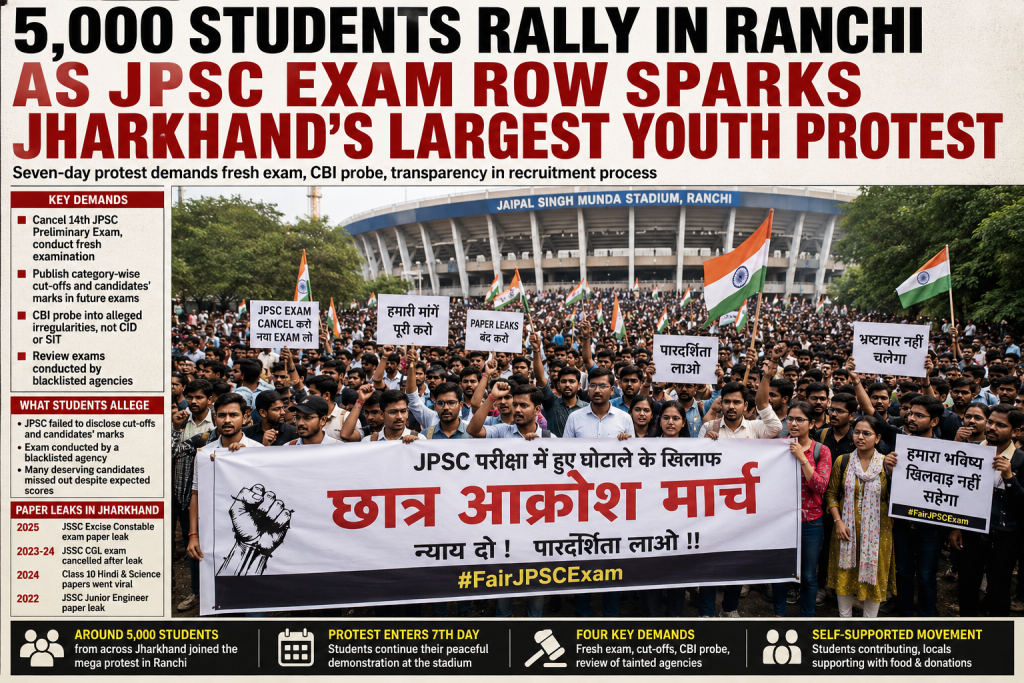
Around 5,000 students from across Jharkhand have converged in Ranchi to protest alleged irregularities in the Jharkhand Public Service Commission (JPSC) examination process, demanding a fresh and transparent examination, a CBI investigation, and sweeping reforms in the state’s recruitment system.
The protest, which entered its seventh day, has emerged as one of Jharkhand’s largest student-led movements in recent years. Beginning with a small gathering at Bapu Vatika on July 25, the agitation gained momentum on July 29 when thousands of aspirants marched through Ranchi carrying the Indian Tricolour and copies of the Constitution before assembling at Jaipal Singh Munda Stadium, where the demonstration continues peacefully.
The controversy centres on the JPSC preliminary examination results declared on July 2. Protesters allege that the commission failed to disclose category-wise cut-off marks and individual scores, leaving candidates uncertain about the selection process. They also claim that the agency involved in conducting the examination has previously faced allegations and has reportedly been blacklisted in several states.
Many aspirants say they expected to qualify based on previous years’ cut-off trends but were declared unsuccessful after the results were announced. As similar complaints surfaced from candidates across the state, the protest evolved into a broader movement demanding transparency and accountability in public recruitment.
The students have placed four key demands before the government: cancellation of the 14th JPSC Preliminary Examination and the conduct of a fresh, fair examination; publication of cut-off marks and candidates’ scores in future recruitment processes; a CBI probe into the alleged irregularities, rejecting investigations by the CID or SIT; and a review of examinations conducted through agencies facing allegations of malpractice.
Despite limited institutional support, the protesters have continued their agitation through self-organisation. Students initially survived on simple meals arranged through pooled contributions, while local residents have recently stepped in with food and donations. Many aspirants have also shared their personal struggles, describing years of preparation, financial hardship and uncertainty surrounding government recruitment.
The agitation has also revived concerns over repeated examination controversies in Jharkhand. In recent years, the state has witnessed allegations of paper leaks in several major recruitment and academic examinations, including the JSSC Combined Graduate Level examination, the Excise Constable recruitment examination, the JSSC Junior Engineer examination and Class 10 board papers, fuelling widespread concerns about the credibility of the examination system.
The Ranchi protest has also drawn comparisons with other high-profile student movements across the country. While the demonstrators have maintained that their campaign is non-political and focused solely on examination transparency and the future of aspirants, they have questioned why their movement has received relatively little political, celebrity or social media attention despite attracting thousands of participants.
With no resolution yet in sight, the students have vowed to continue their peaceful protest until their demands are addressed, insisting that restoring transparency and fairness in recruitment is essential to protecting the aspirations of thousands of young people across Jharkhand.