
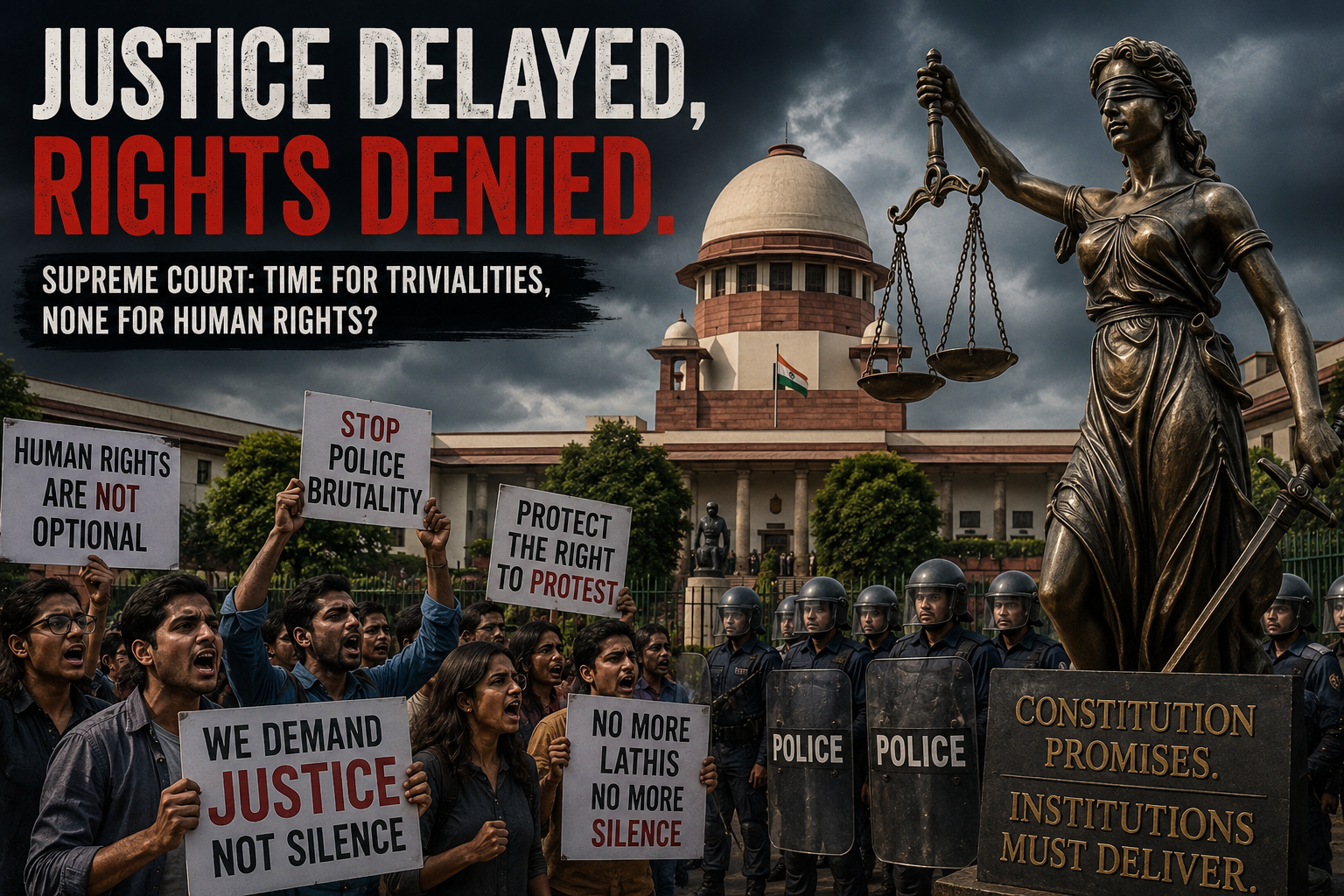
New Delhi: The Supreme Court’s refusal to urgently hear petitions alleging police brutality against protesters has reignited a debate over the judiciary’s priorities and its role in safeguarding fundamental rights.
The controversy stems from petitions filed after the July 20 police action against youth protesters in Delhi, where demonstrators alleged excessive use of force, including baton charges, pellet guns, tear gas and mass detentions. Petitioners sought immediate judicial intervention, arguing that the protests had resulted in serious violations of constitutional rights. During the hearing, the Court declined to entertain the plea urgently, reportedly observing that it did not have time to examine the videos submitted as evidence.
The decision has prompted criticism from civil rights advocates, who argue that allegations of police excesses deserve immediate judicial scrutiny, particularly when they involve claims of injuries, arbitrary arrests and excessive force against unarmed civilians.
Critics have contrasted the Court’s response with the considerable judicial time devoted to other matters over the years. They point to long-running disputes such as the Assam–Nagaland border case, which has remained before the Supreme Court for decades, and the Ayodhya title dispute, which occupied courts for nearly seven decades before a final verdict was delivered in 2019.
They have also cited a number of public interest litigations that, despite having limited practical impact, were nevertheless heard by the Court. These include petitions seeking to replace the word “Sindh” in the National Anthem, bring back the Kohinoor diamond from the United Kingdom, challenge a judicial oath over the omission of a single word, and ban paper currency in favour of digital transactions.
Against this backdrop, critics argue that petitions concerning alleged violations of the right to life, personal liberty and peaceful protest should receive equal, if not greater, urgency.
The debate has intensified following the Bihar government’s decision to withdraw criminal cases against student protesters and release those arrested during demonstrations. Supporters of the movement describe the decision as evidence that sustained public mobilisation achieved concessions that judicial intervention failed to secure. Others, however, caution against viewing street protests as a substitute for constitutional institutions, stressing that an independent judiciary remains the primary guardian of fundamental rights.
Legal commentators have also renewed calls for greater police accountability. They argue that any allegations of unlawful use of force, arbitrary detention or custodial abuse should be investigated independently, and where evidence exists, officials responsible should face proceedings under applicable provisions of the Bharatiya Nyaya Sanhita and other relevant laws.
The controversy has evolved into a broader conversation about judicial priorities, institutional accountability and the balance between maintaining public order and protecting constitutional freedoms. As demands for independent investigations continue, the episode has once again placed the Supreme Court’s role in defending civil liberties under intense public scrutiny.


Ray ID: 8f3a2c1b9d4e5f6a · Performance & security by Cloudflare
site-verification-ok