
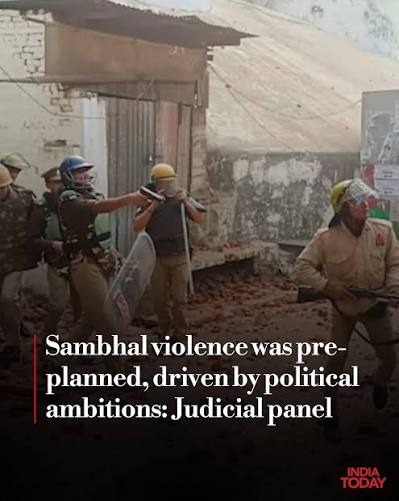
New Delhi: Samajwadi Party (SP) MP Zia-ur-Rahman Barq has strongly rejected the findings of a judicial commission that blamed him for allegedly orchestrating the November 2024 Sambhal violence, asserting instead that the unrest was “pre-planned” by the Uttar Pradesh Police and the state government.
The three-member judicial commission, headed by former Allahabad High Court judge Justice Devendra Kumar Arora, submitted its report to the Uttar Pradesh government last year. The report was tabled in the State Assembly on Wednesday and concluded that the violence was the outcome of a planned conspiracy allegedly involving Barq, Suhel Iqbal—the son of SP MLA Iqbal Mehmood—and members of the Shahi Jama Masjid management committee. It also cleared the Uttar Pradesh Police of responsibility for the deaths that occurred during the violence.
The unrest broke out on November 24, 2024, when an Archaeological Survey of India (ASI) team arrived to conduct a court-ordered survey of the Shahi Jama Masjid. As local residents gathered outside the mosque in protest, clashes erupted, followed by police action in which several people were killed and many others injured.
The commission concluded that the violence was not spontaneous but the result of a conspiracy allegedly motivated by political interests and an effort to retain influence over the mosque. It cited WhatsApp messages mobilising crowds, Barq’s public remarks before the second survey, and telephone conversations between Barq and mosque committee members as evidence supporting its findings.
The panel further ruled that the deaths were not caused by police firing. Based on post-mortem reports, forensic evidence and ballistic analysis, it said the victims sustained injuries from .315-bore firearms, weapons that the commission stated were not carried by police personnel deployed at the site. According to the report, the fatalities were likely caused by cross-firing among alleged miscreants within the crowd. It also noted that relatives of the deceased did not accuse the police of causing the deaths in their statements before the commission.
The report described the violence as a “grave and deadly threat to national security,” documenting incidents of stone-pelting, arson, attacks on police personnel, damage to public property and the alleged snatching of police ammunition. Investigators also reported recovering a 12-bore shotgun shell marked “Made in USA,” describing it as a matter warranting further investigation.
Rejecting the report, Barq said he agreed with only one conclusion—that the violence had been “pre-planned”—but insisted that the planning was carried out by the police administration and the government rather than local residents.
“It was not pre-planned by the public; it was pre-planned by the police administration and the government,” Barq said.
The SP MP questioned why authorities had failed to produce any photographic or video evidence showing local residents carrying or firing weapons despite claiming to possess CCTV footage and mobile recordings. He further alleged that unarmed civilians were killed, more than 100 innocent residents were jailed, and accused the government of withholding the commission’s report for nearly a year before presenting it in the Assembly just months ahead of elections for political advantage.
SP MP Mohibullah Nadvi also criticised the commission, claiming that Barq and Suhel Iqbal had been implicated as part of a predetermined narrative. According to Nadvi, their intervention during the unrest helped prevent further loss of life.
The Sambhal dispute originated on November 19, 2024, when Hindu petitioners approached a local court claiming that the Shahi Jama Masjid had been built over the site of the historic Hari Har Temple. The court ordered surveys of the mosque on November 19 and November 24, with the second survey triggering widespread protests and violence.
The commission’s findings differ sharply from an independent fact-finding report released in July 2025 by the Association for Protection of Civil Rights (APCR) and Karwan-e-Mohabbat. Titled “Sambhal: Anatomy of an Engineered Crisis,” the report described the violence as targeted anti-Muslim violence and alleged excessive police force, state complicity and systematic repression. It claimed that police firing resulted in the deaths of five Muslim men, while dozens of residents—mostly Muslims—were arrested and subjected to mass detentions, intimidation and demolitions in the aftermath.
The contrasting accounts have intensified the debate over the events in Sambhal, with the judicial commission placing responsibility on political leaders and mosque officials, while independent rights groups continue to allege police excesses and state complicity.