
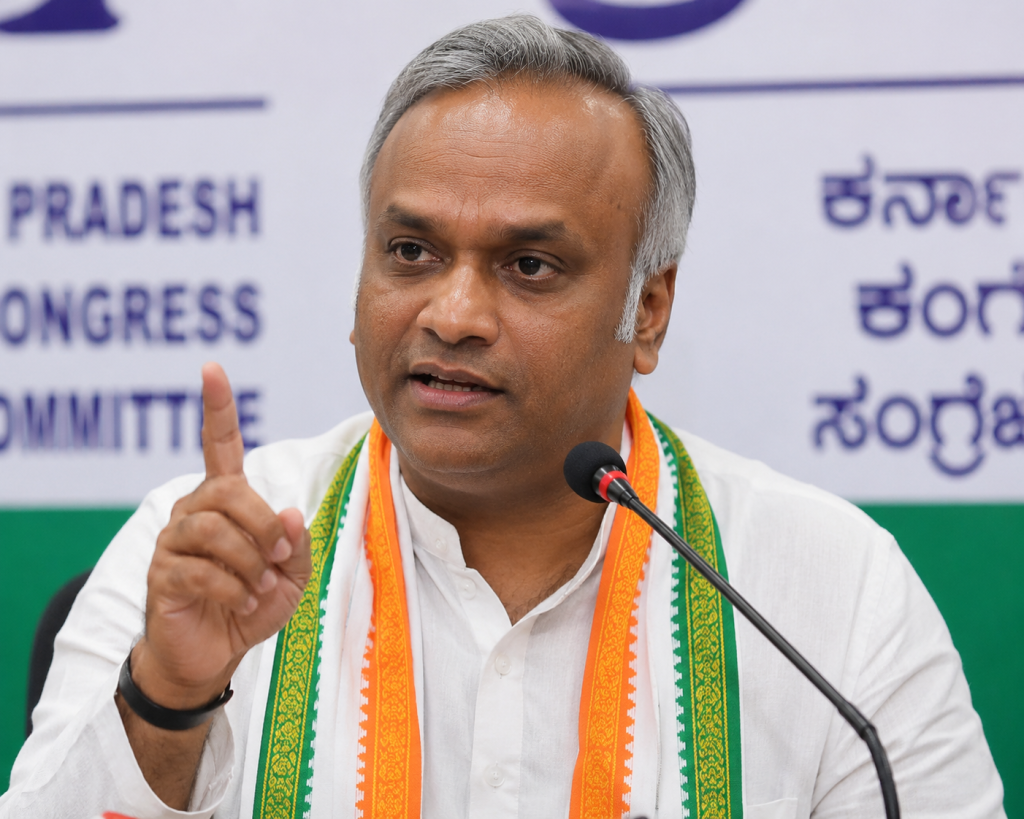
Karnataka Home Minister Priyank Kharge has renewed his demand that the Rashtriya Swayamsevak Sangh (RSS) register itself under a legal framework, warning that the Karnataka government could introduce legislation to make registration mandatory if the organisation continues to operate without it.
Speaking at a conference titled “Why Registration of the RSS is Necessary” in New Delhi, organised by Samajwadi Sangam, Kharge sharply criticised the RSS, alleging that it portrays itself as the sole custodian of patriotism while questioning the nationalism of others.
Kharge described the RSS as “the most unpatriotic and anti-national organisation in the history of India” and argued that any organisation with such a wide social and political influence should function within a transparent legal framework.
The Congress leader revealed that shortly after assuming office as Karnataka’s Home Minister, he had written to RSS chief Mohan Bhagwat urging the organisation to register itself. According to Kharge, no response was received to the letter.
“I expected there would be no reply, but this is only the beginning,” he said, adding that the state government is prepared to explore legal measures if necessary.
Warning of possible legislative action, Kharge said that if the RSS continues to operate without registration, the Karnataka government could introduce a law requiring the organisation to formally register. He added that failure to comply with such a law could invite legal consequences, including the possibility of a ban.
Kharge also alleged that the RSS had historically opposed India’s Constitution and the national flag during various periods after Independence. He claimed the organisation had organised protests against the Constitution and questioned its commitment to constitutional values.
Senior advocate Prashant Bhushan, who also addressed the event, said the issue of the RSS’s legal status had become an important constitutional debate. He argued that strengthening constitutional values was essential to counter the organisation’s growing influence.
The remarks come weeks after RSS chief Mohan Bhagwat rejected similar demands for registration, stating that the organisation functions openly and that many institutions and traditions in India are not formally registered. Bhagwat dismissed the demand as a political exercise, saying the RSS has nothing to hide and has faced similar criticism in the past.
Founded in 1925, the RSS has been banned three times in independent India—after Mahatma Gandhi’s assassination in 1948, during the Emergency in 1975, and following the demolition of the Babri Masjid in 1992. The final ban was lifted in 1993.