

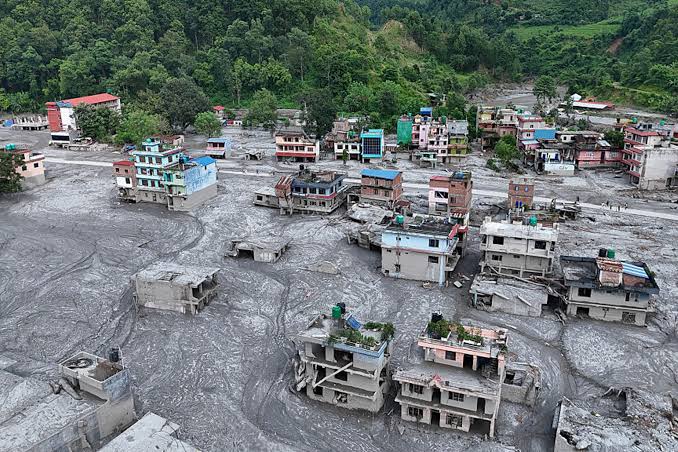
Climate disasters are often described as acts of nature. But when a country that has contributed little to global warming suffers catastrophic losses, that description begins to look inadequate. As the death toll from Nepal’s devastating flash flood continues to rise and the scale of destruction becomes clearer, Nepal is asking a question that goes beyond emergency relief. It is asking if the climate crisis is the product of unequal contributions, should its costs also be shared unequally?
Following the 26th August 2026 flash flood that swept through parts of northern and central Nepal, the Nepal government is seeking compensation from major greenhouse gas emitters. Nepal’s Foreign Minister Shisir Khanal described post-disaster assistance “not as a charity” but as a matter of “legal and moral liability.”
Khanal has called the disaster a “warning signal” of the risks that climate change poses to Nepal. Prime Minister Balendar Shah, writing on social media, has linked the flood directly to climate change. Pointing to the increasing evidence that the temperature in the Himalayan region has increased by 1.8 degrees, Nepal is now turning this argument into a demand for climate compensation.
Well, this demand is not surprising. Climate change is deeply intertwined with both global and local inequalities. Studies are exposing how the countries and populations that have benefited most from the common intensive economic development are not necessarily those facing its consequences.
20 of the 36 highest emitting countries were among those least vulnerable to the negative impact of climate change, while 11 of the 17 countries with low or moderate emissions were acutely vulnerable. Environmental Justice scholars are warning that this inequality is likely to worsen, describing some countries as effectively “free riders” whose emissions leave others to bear the climate burden. This is precisely why climate change must be understood as an issue of environmental justice and not simply as an environmental problem.
Democracy Buried in Bastar: The Tragic Tale of Mukesh Chandrakar
Environmental justice, in its simplest form, asks whether environmental benefits and burdens are distributed fairly and whether the process through which these burdens are allocated is itself fair. Economic development should not allow one country to enjoy its benefits while transferring its environmental costs to others or to future generations. It is not only about equal distribution of benefit and harm, but it is also about who has a voice in environmental decision-making, who has access to information and whether the affected communities can participate in decisions that shape their lives. These inequalities can also be produced within wealthy countries. During Hurricane Katrina, the flood protection decisions benefited higher-value properties at the expense of poorer communities.
Nepal is making this inequality more visible after the Bhotekoshi flood. Nepal claims that it contributes negligibly to global greenhouse gas emissions, yet faces serious and growing climate-related risks. Studies on the Nepali Himalaya have shown that its climate-sensitive social and ecological systems are significantly exposed to climate change and extreme weather events with limited capacity to adapt.
Himalayan ‘vulnerability’ has increasingly been framed as an issue of climate justice and shared international responsibility. The idea of Climate Loss and Damage becomes important here. It refers to the unavoidable consequences of climate change that exceed countries’ capacity to adapt. Nepal has estimated the cost of recovery at approximately $5 billion and has sought urgent assistance from the Board of the Fund for Responding to Loss and Damage, a United Nations mechanism established to support countries facing climate-related loss and damage.
India-US Defence Pact: A Strategic Boost for Indias Military Modernisation
However, resources available with the fund are dramatically smaller than the losses vulnerable countries are reporting. As of now, around $822 million has been pledged to the fund; requests from countries already exceed the demand. This gap exacerbates disparities in the impacts of climate change.
Well, Nepal is not alone in asking for environmental justice. Its demand is a part of a much larger transformation in global climate politics. For years, climate-change-vulnerable countries have argued that the climate crisis and its impacts cannot be addressed solely through promises to reduce future emissions. For communities already losing lives and livelihoods, the environmental harms are no longer a hypothetical future problem.
Pacific Island states have been particularly influential in pushing this argument onto the global stage. Vanuatu supported a Pacific Island youth-led campaign to take the question of climate justice to the world’s highest court. And the result was significant. In July 2025, the International Court of Justice issued a landmark advisory opinion on states’ obligations regarding climate change impacts. Even though the opinion is not itself legally binding, the decision strengthens the possibility that states could seek legal remedies for climate harm, including harm associated with historical emissions.
Environmental destruction is increasingly being discussed globally through the language of legal responsibility as well. For the last few years, the debate to recognise “ecocide” as an international crime has gained significant momentum. International Criminal law has traditionally focused on genocide, crimes against humanity, war crimes and aggression. Environmental destruction has largely remained outside this framework.
In September 2024, Vanuatu, Fiji and Samoa formally proposed adding ecocide as the fifth international crime. Their proposal defines ecocide as “unlawful or wanton acts committed with knowledge that there is a substantial likelihood of severe and either widespread or long-term damage to the environment being caused by those acts.” The language of ecocide is already entering political disputes. Lebanon, for instance, has accused Israel of committing ecocide, arguing that its military operations caused extensive harm to forests, agricultural land, water resources, air quality and ecosystems.
Nepal has identified China, the United States and India among the major emitters from which it believes compensation should be sought. But even here India can contest. India currently produces around 8% of annual global carbon emissions, yet its per-capita emissions were only about 2.2 tonnes in 2024, far below countries such as the United States, at 14.2 tonnes per person. Historically, India accounts for only about 3.6% of cumulative global carbon emissions since 1751.
Climate justice cannot merely mean shifting responsibilities to the major polluters. The legal and ethical framework for distributing emission responsibility is challenging. Should responsibility be based on present annual emissions? Or should we look into historical cumulative emissions?
Justice Delayed: Supreme Court Finds Time for Minor Issues, Not Human Rights
There may never be a perfect answer. But complexity cannot become an excuse for inaction. For decades, greenhouse gas emissions have altered the climate. Nepal’s argument is straightforward: despite contributing negligibly to global greenhouse gas emissions, it is currently experiencing disproportionate consequences of global warming that include glacier melt and increasingly dangerous mountain hazards. By demanding compensation, Nepal is changing the language through which natural disasters are understood. The conversation is not about financial aid anymore, but about the unequal relationship between contribution to environmental harm and responsibility for its consequences.
(Bhavya Tandon is an Assistant Professor & Assistant Dean, ACT (Clinic) at Jindal Institute of Behavioural Sciences)