
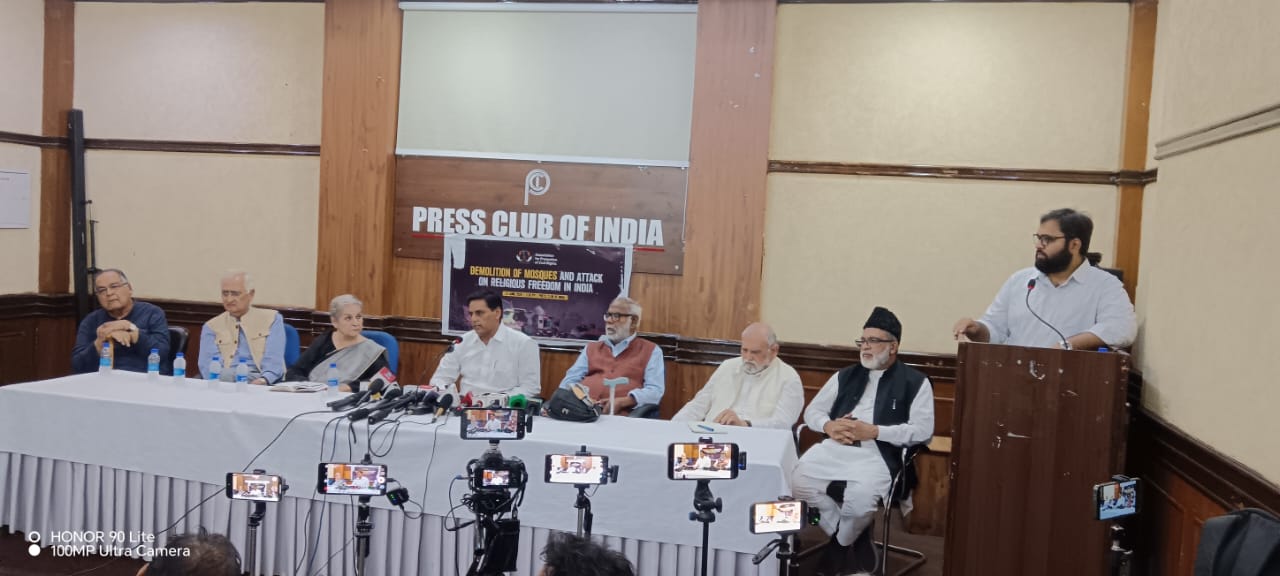
New Delhi, 24 June 2026 — The Press Club of India in New Delhi was the venue for a powerful and impassioned gathering on Monday, as the Association for Protection of Civil Rights (APCR) organized a poignant press conference titled “Demolition of Mosques and the Assault on Religious Freedom in India.” The event united community leaders, activists, journalists, and concerned citizens to shed light on the alarming surge in state-led demolitions targeting Muslim religious sites and properties across the nation.
APCR National Secretary Na issued a stark warning: “There is a well-organized and systemic conspiracy to demolish mosques, madrasas, religious shrines, and Muslim properties—reminiscent of the lync of 2016 and 2017. What we are witnessing today is collective punishment aimed at eroding Muslim presence and identity.” He accused the current government of orchestrating a calculated campaign to demonize and demoralize the Muslim community, emphasizing that these demolitions are not isolated incidents but part of a larger, sinister agenda.
Renowned former Union Minister Salman Khurshid expressed deep concern over this escalating crisis. Highlighting the importance of legal preparedness, Khurshid urged affected communities to diligently maintain their documents and legal records, advocating for a robust judicial response to unjust demolitions.
The session opened with a heartfelt account by Reyasat Ali, an advocate from Meerut, who vividly recounted his community’s distressing experience. Ali drew attention to the ongoing dispute over the “Thane Wali Masjid,” a local Jama Masjid situated within the premises of the Kharkhoda Police Station in Meerut, Uttar Pradesh. Following a revenue department survey, police issued a seven-day notice to the mosque’s imam on June 13, 2026, demanding submission of ownership documents and the removal of alleged unauthorized constructions. His testimony set a somber tone for the gathering, illuminating the distress and uncertainty faced by countless Muslims in the region.
Following Ali’s account, a representative from Sambhal district shared a similarly troubling story: four mosques and an Eidgah had recently been razed—a stark indication of a disturbing pattern unfolding across the country.
Saadat Hussain from Jaipur recounted his personal ordeal, describing demolitions in Rajasthan’s Nandpuri and Barmer districts, which he characterized as targeted attacks on Muslim neighborhoods. Similarly, Adil Khan from Varanasi detailed the demolition of his house and shops—projects he attributed to development initiatives like road widening, though he emphasized that such projects disproportionately impact Muslim properties under the guise of progress.
Malik Motasim Khan, Vice President of Jamaat-e-Islami Hind, voiced grave concern over the rising tide of hatred. Describing the current situation as a “tsunami of hatred,” he warned that the government perceives mosques, dargahs, and madrasas as obstacles to its long-standing agenda of marginalization. He outlined four strategic pillars to resist this offensive: steadfastness and spiritual resilience, embodying Islamic character, prioritizing education, and strengthening economic foundations.
Adding a broader perspective, senior journalist John Dyal pointed out that the targeting extends beyond Muslims. “Christians are also being targeted and persecuted,” he emphasized, highlighting the growing communal polarization threatening the fabric of Indian society.
In his concluding remarks, veteran journalist and former Chairman of the Delhi Minorities Commission, Dr. Zafarul-Islam Khan, contextualized this wave of violence within a larger historical framework. “What we see today,” he stated, “is merely a fragment of a long-standing agenda. The ultimate goal is the implementation of the RSS’s centennial vision of cultural and religious homogenization.”
Dr. Khan argued that issues such as mosque demolitions, house demolitions, and what he termed “bulldozer politics” are part of a broader socio-political process that has been unfolding since 2014. He claimed that long-standing ideological objectives associated with the RSS are gradually being realized, portraying Muslims, Christians, and others as adversaries in this narrative.
He urged community members to stay active, organized, and unbiased, encouraging youth to engage in democratic and legal efforts. He emphasized the importance of pursuing legal remedies through the High Courts and the Supreme Court—even when success seems uncertain. According to him, court cases serve to create a historical record of grievances and injustices, citing the Babri Masjid dispute as an example of how legal and historical findings remain significant regardless of the final verdict.
Khan also underscored the importance of systematically documenting human rights violations and making this information accessible both nationally and internationally. He recommended engaging with global human rights organizations and the United Nations by preparing detailed, well-documented reports in English.
Advocating restraint and non-violent resistance, he advised communities to avoid reactions that could provoke further repression. He also called for challenging certain government policies, including border fencing, through legal channels. Concluding his remarks, Khan reaffirmed that legal action, documentation, and international advocacy are vital tools for accountability and for preserving a record of these events for future generations.
The event closed with a heartfelt call for unity and resilience, urging all communities and allies to stand firm against the ongoing assault on religious freedom and minority rights. As the voices of concern echoed through the halls of the Press Club, the message was clear: the fight for justice, dignity, and pluralism in India must continue relentlessly.
Participating activists and speakers included former MP Mohammad Adeeb, and social activist Syeda Hameed.